Liquid extract
A liquid material derived from cultivated watermelon through our bioconversion process. Its composition and analytical profile guide ingredient evaluation, formulation work and biological research.
We develop liquid extract and fibre from whole watermelon for cosmetic ingredient evaluation and potential nutraceutical, food and medical research applications.
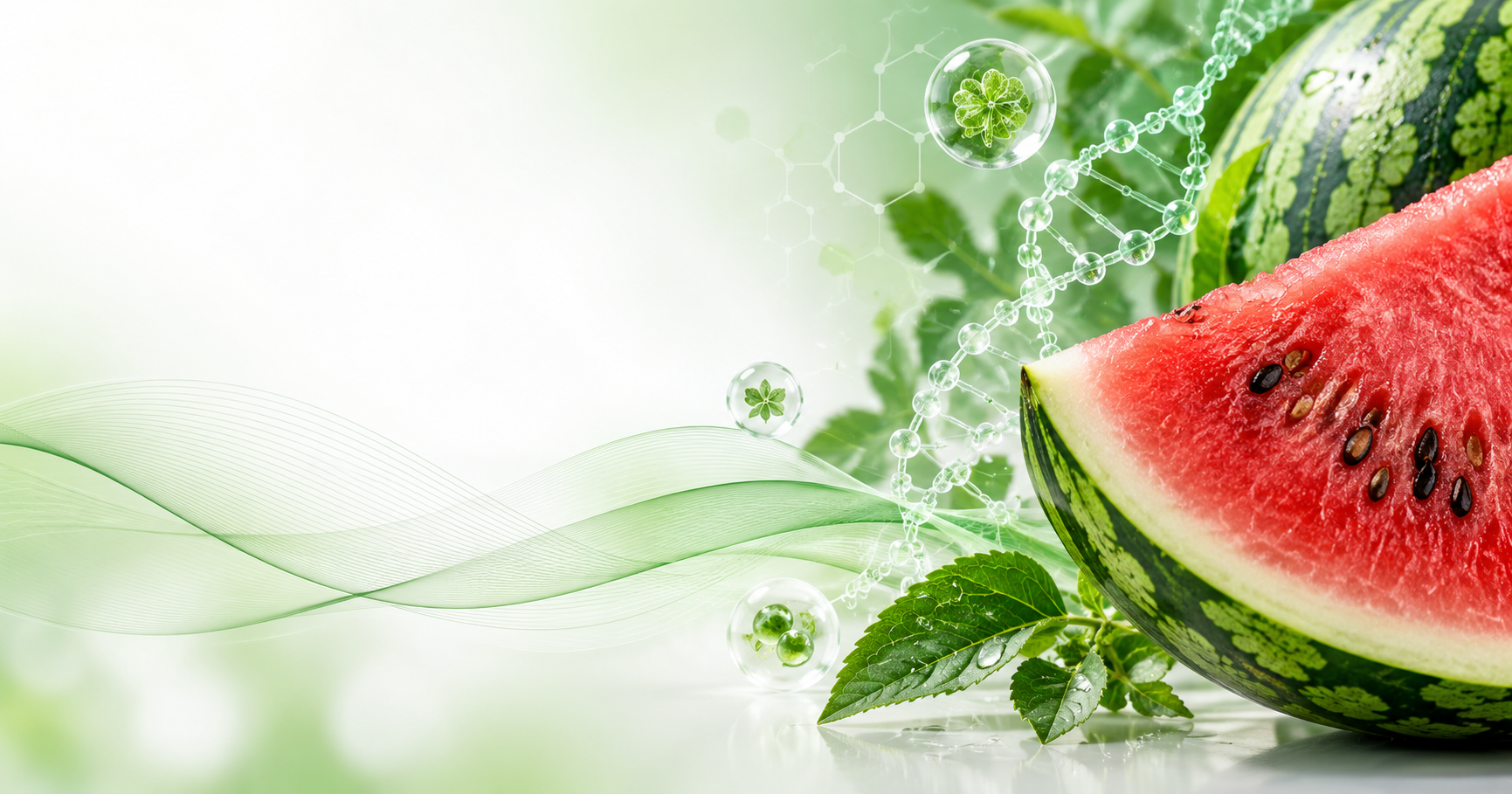
Whole-watermelon bioconversion produces a liquid extract and a fibre-rich solid fraction. We develop these materials as starting points for partner-led ingredient and product development.
A liquid material derived from cultivated watermelon through our bioconversion process. Its composition and analytical profile guide ingredient evaluation, formulation work and biological research.
The recovered fibre-rich solid material provides a second development stream. Potential uses include food ingredient and biomaterial research, with composition and functional properties to be assessed for each use.
Cosmetics are a current evaluation focus. Nutraceutical, food and medical research applications form the wider development opportunity.
Evaluate the liquid extract as an ingredient for creams, serums and other topical formulations. Development work can examine formulation compatibility, stability, skin tolerance and performance.
For: Cosmetic formulators, skincare brands and ingredient developers.
Explore whether the extract or further-developed fractions could support supplement and nutritional formulations. Priorities include composition, suitable delivery format, oral safety, stability and evidence for any proposed benefit.
For: Supplement developers and nutrition research teams.
Investigate the extract and fibre fraction as candidate ingredients for food and beverage development. The next questions include taste, texture, microbiological quality, processing compatibility and shelf life.
For: Food manufacturers, beverage developers and food scientists.
Investigate the materials in hydrogel, topical-delivery and skin-repair research programmes. These are research directions requiring biological testing and application-specific development.
For: Biomaterials researchers, university laboratories and medical development partners.
These are ingredient development and research pathways. Suitability, safety and performance must be established for each intended use; food, supplement and medical applications are not presented as approved finished products.
A development approach focused on using more of the cultivated watermelon fruit.
Designed around the fruit's native moisture during the conversion process.
Measure, compare and improve through analytical characterisation.
La Grace Bio (Pty) Ltd develops a whole-biomass bioconversion platform for cultivated watermelon (Citrullus lanatus). Founded by Pierre van der Merwe, the company brings together native-moisture processing and analytical characterisation to explore bio-based ingredient development.
Our focus connects physical outputs to ingredient development, research and licensing across cosmetics, nutraceuticals, food and medical research. The platform is associated with international patent application PCT/IB2025/061059.
Plant materials vary with growing conditions and handling. Our development approach is process-defined so outputs can be characterised, compared and improved.
Cultivated Citrullus lanatus is the starting material. Knowing the input is the first step toward understanding the output.
Whole-biomass bioconversion uses the fruit's native moisture. The development process avoids adding water during the core conversion stage.
Analytical testing is used to understand composition and compare samples. That evidence guides development decisions.
CPUT analytical work provides a foundation for understanding tested material.
Stellenbosch analytical work adds a detailed view of submitted samples' biochemical profiles.
PCT/IB2025/061059 was filed in October 2025 and remains pending.
We welcome focused conversations with ingredient developers, formulators, research teams and potential licensees.
Our PCT Chapter II filing, including Article 34 amendments, was submitted on 4 September 2026 for PCT/IB2025/061059.
La Grace Bio's development journey includes semifinalist recognition in the Global Cleantech Innovation Programme South Africa.
Top 3 in the Eastern Cape NCIC Waste-to-Value Challenge, 2026.